
You can improve coordination with simple drills by engaging in exercises like catching and throwing a ball, balancing on one leg, or jumping rope, which enhance neuromuscular control and spatial awareness. Incorporating movement patterns such as walking or jumping while performing these tasks adds challenge and promotes full-body coordination. Consistency is key, and gradually increasing difficulty helps progress. Keep exploring different strategies, and you’ll discover more ways to boost your coordination effectively.
Key Takeaways
- Incorporate ball tossing and catching to enhance hand-eye coordination and reaction time.
- Practice balance exercises like single-leg stands or wobble board activities to improve stability.
- Use simple movement drills such as jumping rope or stepping patterns to develop full-body coordination.
- Gradually increase drill complexity, speed, or movement variability to challenge and progress coordination skills.
- Combine physical exercises with cognitive tasks to strengthen neural pathways and overall coordination.
Understanding the Role of Coordination in Daily Life
Understanding how coordination functions in daily life is crucial because it underpins many of your routine movements, from walking to reaching for objects. Coordination involves motor control—your brain’s ability to organize muscles and limbs for precise actions. When you perform daily tasks, your senses, like vision and hearing, integrate seamlessly with motor control to guide your movements accurately. This integration ensures smooth, effective physical activity, whether stepping onto a curb or typing on a keyboard. Proper coordination not only enhances task efficiency but also acts as a safety mechanism, helping you react quickly to environmental changes and prevent falls or injuries. Because coordination operates largely subconsciously, you often don’t realize how much it influences your safety and independence. Maintaining and improving your coordination through consistent daily practice is essential for sustaining functional independence and overall quality of life. It’s a foundational skill that supports your ability to navigate and interact with your environment confidently.
Key Types of Coordination and Their Benefits
Understanding the different types of coordination helps you identify which skills support daily activities and overall well-being. Fine motor skills enhance precision in tasks like writing, while gross motor skills improve strength and stability. Recognizing how hand-eye coordination integrates visual input with movement can boost performance and safety across all ages.
Types for Daily Life
Different types of coordination play essential roles in your daily life, helping you perform a wide range of tasks safely and effectively. Motor coordination, for example, involves large muscle groups that support walking, running, and lifting—crucial for maintaining mobility and independence. Fine motor coordination, focused on small muscles like those in your hands and wrists, is key for activities such as writing, sewing, and buttoning clothes. Hand/eye coordination combines visual information with motor responses, critical for driving, cooking, and catching objects. Regular coordination exercises enhance balance, reduce fall risk, and improve overall motor skills across all ages. Strengthening these different coordination types boosts your safety, efficiency, and confidence in daily physical activities, making everyday tasks more manageable and less risky.
Benefits Across Ages
As you progress through life, developing and maintaining various coordination skills offers essential benefits at every age. Coordination, including gross and fine motor skills, underpins daily activities like walking, writing, and functional independence. Regular drills can enhance balance and motor control, which is especially crucial for older adults, reducing fall risk by nearly 40%. For children, activities that boost hand-eye coordination improve learning and sports performance, enhancing visual tracking and reaction time. In seniors, balance and proprioception exercises help preserve mobility and independence, supporting healthy aging. Throughout your lifespan, consistent coordination practice fosters neural development, movement efficiency, and physical confidence. Building these skills not only improves functionality but also contributes to overall quality of life, regardless of age.
Simple Drills to Enhance Hand-Eye Coordination
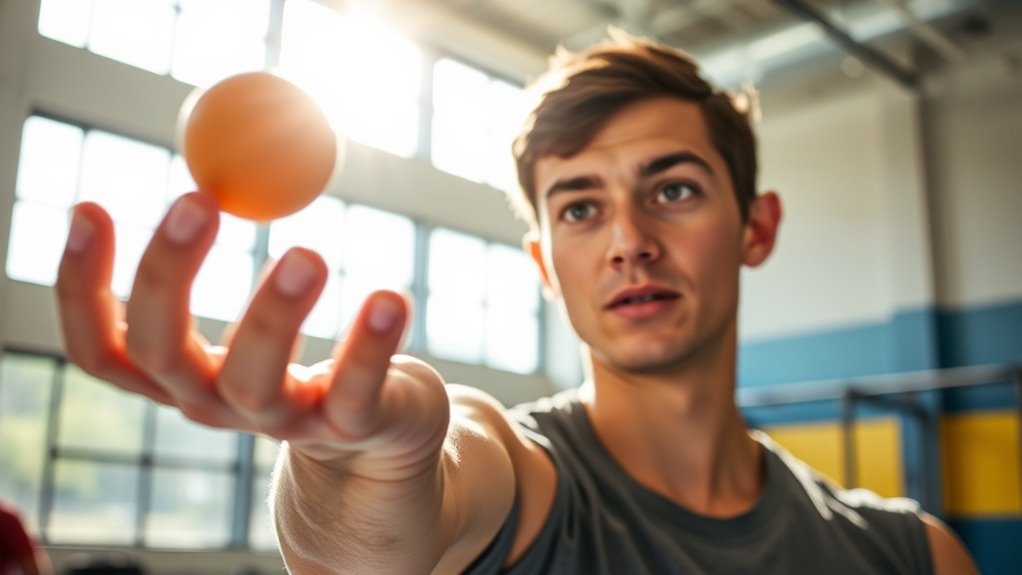
Starting with basic ball tossing techniques allows you to refine your hand-eye coordination through controlled movements. Incorporating target practice strategies helps you focus on precision and timing, gradually increasing difficulty. Consistent, mindful practice of these drills can lead to noticeable improvements in motor control and reaction speed.
Ball Tossing Techniques
Ball tossing drills are a simple yet highly effective way to improve your hand-eye coordination by sharpening visual tracking and timing skills. By varying the speed, height, and distance of your throws, you challenge your reaction time and motor control, fostering more precise movements. Using one or two balls in different positions—front, side, or behind—adds complexity and activates multiple muscle groups, enhancing overall coordination. Incorporating movement, like walking or jumping, further refines the connection between eye, hand, and body. Regular practice with these techniques leads to measurable improvements in agility and reaction speed. Here’s a quick overview:
| Technique | Focus |
|---|---|
| Varying throw parameters | Reaction time, motor control |
| Multiple ball positions | Visual tracking, coordination |
| Dynamic movement | Body-eye coordination |
| Catching and bouncing | Hand-eye synchronization |
| Consistent practice | Overall athletic improvement |
Target Practice Strategies
Target practice drills are an effective way to sharpen your hand-eye coordination by demanding precise visual targeting and controlled motor responses. By focusing on aiming at specific spots or objects, you train your brain to process visual cues and translate them into accurate movements. To enhance your skills, consider these strategies:
- Gradually increase the distance and complexity of your aiming targets to challenge neural connections.
- Incorporate movement, like throwing while walking, to simulate real-life coordination demands.
- Vary angles and speeds during target practice to reinforce neural pathways and improve adaptability.
- Use feedback to adjust your aim, refining spatial awareness and precision over time.
These simple drills foster better motor responses and sharper visual targeting, ultimately boosting your overall coordination.
Incorporating Movement and Mental Challenges Into Routine Exercises
Incorporating movement and mental challenges into routine exercises is a proven way to enhance neural pathways, resulting in better coordination and faster response times. By integrating motor tasks with cognitive demands, you actively engage your brain during coordination training, strengthening the mind-body connection. These mind-body exercises promote neuroplasticity, which is critical for maintaining motor skills as you age. For example, combining physical movement with mental tasks like counting backward or solving puzzles not only stimulates neural connectivity but also improves overall motor learning. Dual-task exercises, which merge movement with mental calculations, have been shown to substantially reduce fall risk, highlighting their practical benefits. Regularly adding these challenges to your workouts ensures your brain and body work in harmony, enhancing coordination and response speed. This approach creates a more dynamic, effective training routine that taps into your brain’s adaptability, helping you develop resilient, well-coordinated motor skills.
Using Common Objects for Effective Coordination Practice
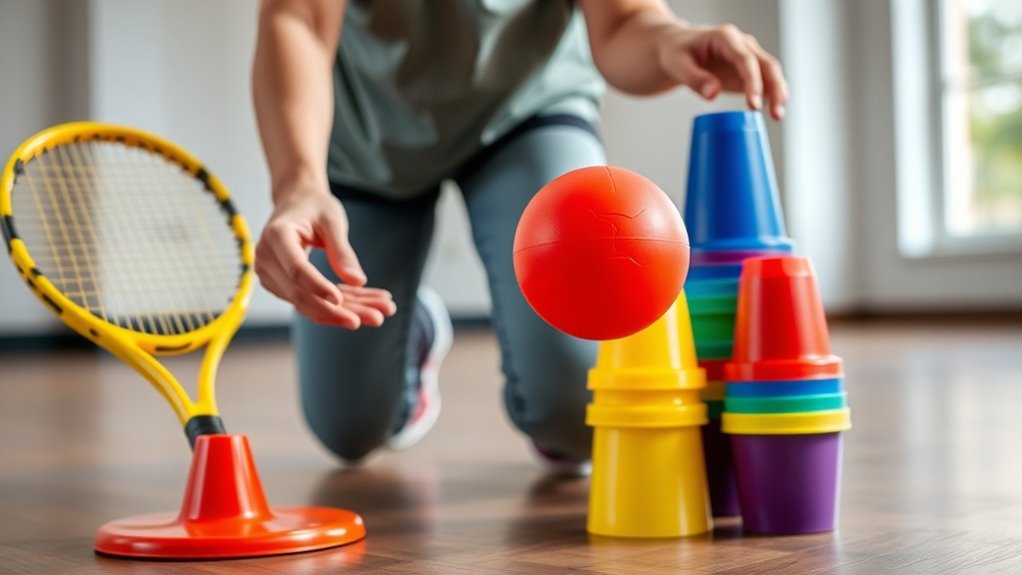
Using common household objects for coordination practice offers an accessible and effective way to enhance motor skills without specialized equipment. Everyday objects like tennis balls, balloons, and jump ropes serve as versatile tools to develop hand-eye coordination through targeted drills. These items allow you to focus on reaction time, accuracy, and neural pathways involved in coordination, making practice both practical and engaging. Varying the size, weight, and movement patterns of these objects challenges different aspects of coordination, fostering well-rounded motor skill development. Incorporating familiar items makes consistent practice more sustainable and less intimidating. To maximize benefits, consider these approaches:
- Tossing and catching small balls to improve reaction time.
- Using balloons for hand-eye tracking exercises.
- Jumping over or through jump ropes to enhance timing.
- Incorporating rings or hoops for spatial awareness drills.
These simple, effective methods support your overall coordination progress while fitting seamlessly into daily routines.
Full-Body Coordination Exercises for Functional Movement
Full-body coordination exercises are essential for enhancing functional movement, as they simultaneously engage multiple muscle groups and promote neuromuscular integration. These exercises, like cross step bear walks, target movement patterns that require coordination of scapular stabilizers, rotator cuffs, hamstrings, and calves, strengthening overall movement quality. By challenging your body’s ability to synchronize limb movements with core stability, you improve neuromuscular control, leading to more fluid, efficient actions. Incorporating locomotion-based drills—such as crossing legs, pivoting, and maintaining hip height—further enhances dynamic coordination and mobility. Regular practice of these full-body movements supports injury prevention by reinforcing proper joint sequencing and muscle activation during everyday activities. Progressing the exercises with variations, like shifting foot directions or increasing complexity, fosters adaptability and helps solidify ideal movement patterns. This focused approach ensures your functional movement becomes more reliable, resilient, and responsive to the demands of daily life.
Tips for Progressing and Maintaining Coordination Training
To effectively progress and maintain your coordination training, it’s crucial to systematically increase the complexity of your coordination drills by adding movement variations, increasing speed, or introducing distractions. This approach challenges neural pathways, encouraging continual adaptation. Incorporate variation in your exercise program by changing tools or environments to prevent plateauing and keep motivation high. Regularly seek feedback through self-assessment or coaching to monitor your progress and adjust difficulty levels accordingly, avoiding frustration. To optimize retention, schedule consistent, shorter practice sessions rather than infrequent, lengthy ones. Additionally, integrating cognitive tasks with physical exercises enhances neural connections, making skills more transferable to real-life situations.
Here are some key tips:
- Gradually add movement variations to your drills.
- Increase the speed of exercises as your coordination improves.
- Use different tools or environments to introduce variation.
- Incorporate feedback to tailor difficulty and sustain progress.
How to Integrate Coordination Drills Into Your Fitness Plan
Integrating coordination drills into your fitness plan can substantially enhance neural efficiency and movement fluidity when approached strategically. Begin by incorporating coordination exercises like jump rope, ball tossing, or ladder drills into your warm-up or cool-down routines. These exercises stimulate neural pathways, promoting more seamless brain-body communication. To maximize effectiveness, progressively increase the difficulty—speed up drills or add complexity—to challenge your coordination skills continually. Schedule dedicated sessions 2-3 times per week, ensuring consistency and steady neural and motor development. Combining cognitive tasks, such as counting backward or multitasking, with physical drills further strengthens neural pathways. Tracking your progress—reaction time, accuracy, or smoothness—helps you identify areas for adjustment, maintaining engagement and promoting growth. By thoughtfully embedding these drills into your training program, you’ll develop better coordination, which supports overall athletic performance and functional movement.
The Impact of Consistent Practice on Balance and Stability
Consistent practice of coordination exercises is essential for enhancing balance and stability over time. Regular training stimulates neural pathways responsible for postural control and proprioception, leading to measurable improvements. Engaging daily in balance-focused activities reduces fall risk by nearly 40%, especially in older adults. The benefits extend beyond neurological improvements, as muscle strength and coordination also increase, contributing to overall stability. To maximize these effects, consider these key points:
- Repetition reinforces neural connections crucial for maintaining balance.
- Persistent training enhances proprioception, improving body awareness.
- Consistency reduces the likelihood of falls by strengthening stabilizer muscles.
- Even populations with neurological impairments can experience meaningful gains through sustained effort.
Through disciplined training, your balance becomes more resilient, your coordination sharper, and your stability more reliable, fostering confidence and safety in daily movement.
Common Questions
What Is the Best Way to Improve Coordination?
The best way to improve coordination is by consistently practicing specific drills like hand-eye coordination, foot agility exercises, and reaction time drills. Focus on enhancing upper-lower synchronization through varied, engaging activities. Gradually increase difficulty to challenge your nervous system, ensuring continuous improvement. Remember, patience and regular practice are key—small, consistent efforts will develop neural pathways, leading to more automatic, fluid movements over time.
How to Improve Coordination in Gymnastics?
Imagine your body as a finely tuned instrument, each movement resonating smoothly. To improve coordination in gymnastics, focus on balance training, enhancing proprioception exercises that sharpen your body awareness. Incorporate agility drills to refine motor skills and develop agility. These techniques strengthen neuromuscular connections, helping you synchronize your movements more effectively, boosting confidence and precision during routines. Consistent practice transforms your coordination into a seamless, controlled performance.
Which Activity Helps Develop Coordination?
You can develop coordination effectively through activities like balance exercises, agility drills, and footwork routines. These focus on enhancing your hand-eye coordination and overall motor control by challenging your stability, speed, and precision. Incorporating these into your training helps improve reaction time and coordination, especially when tailored to your skill level. Consistent practice with these drills fosters a deeper connection between your brain and body, leading to better athletic performance and everyday movement.
What Exercises Improve Balance and Coordination?
To improve balance and coordination, incorporate drill routines like balance exercises, agility training, and obstacle courses into your routine. These activities challenge your neuromuscular system, enhancing stability and movement precision. Combining dynamic movements with cognitive tasks can further boost neural pathways. Consistent practice of these exercises not only improves coordination but also reduces fall risk, making your movements more controlled and confident over time.
To Sum it up
By consistently practicing simple drills, you’ll notice your coordination improving steadily—like building a sturdy bridge over time. Keep in mind that progress may be gradual, but persistence pays off. Incorporate these exercises into your routine with patience and focus, and you’ll enhance your balance, stability, and overall functional movement. Remember, even small steps can lead to big gains—so stay committed, and watch your coordination flourish as you lay a strong foundation for daily confidence and safety.